Thursday, 28 March 2013

Defining posthumanism in 25 words or less

I'm a big fan of '25 words or less competitions'. I've never won one, never really cracked the formula, but I like giving them a go.

Defining posthumanism in 25 words or less is not easy. The Wikipedia entry for posthumanism gives it 5 separate definitions. It took Cary Wolfe an entire book. N. Katherine Hayles has had a few goes at it as well, as have countless other writers.

I'm defining posthumanism for my own specific purpose as part of my practice-led PhD. Naturally, this means it's only one of dozens (hundreds?) of possible definitions, and will open up more questions than it answers. But when I had my first bash at it yesterday this is what I came up with:

Posthumanism is a deliberate act to alter the human body surgically or chemically in order to attain additional skills, abilities or (???) beyond those a human maybe born with. The deliberate act must not merely enhance an existing skill or ability; rather it must create an new one that had not existed before.
Three problems immediately arise with this definition. Firstly, it's generally not good form to have ???? in the middle of a definition. Secondly, it's way over 25 words. Thirdly, (though I'm not sure this is a problem so much as a choice) it tends to focus more on physical attributes rather than philosophical ideals that define a human being.

Going back through the reading I've done on posthumanism, there are several definitions that appeal to me for different reasons. In his book What is Posthumanism, Wolfe quotes Joel Garreau who defines posthumans as:

beings ‘whose basic capacities so radically exceed those of present humans as to no longer be unambiguously human by our current standards.’
In Our Posthuman Future Fukuyama describes posthumanism as a "potential moral chasm" and focuses on the dangers of biotechnology, in particular the use of neuropharmalogical drugs and genetic screening, while in the opening pages of How We Became Posthuman Hayles states:

Whether or not interventions have been made on the body, new models of subjectivity emerging from such fields as cognitive science and artificial life imply that even a biologically unaltered Homo sapiens counts as posthuman. The defining characteristics involve the construction of subjectivity, not the presence of nonbiological components.
 
In a nutshell, then, Garreau thinks posthumans are some kind of superhuman; Fukuyama thinks posthumans are potentially dangerous and socially divisive and Hayles thinks we're all posthumans. Okay, so that's a gross oversimplification but it does help me position my definition of posthuman more towards Garreau and further away from both Hayles and Fukuyama.

This is because I'm framing my definition for a fiction-writing perspective: if I'm to have posthumans in my book, particularly for a young adult novel, I want them to look or act posthuman in some way, and I guess, for me, that means having a skill or ability that no human is born with. Also, I'm writing a speculative fiction manuscript so the notion of the superhuman is not only accepted it is to some degree expected.

So for the purposes of my creative practice research, I'm offering the following definition:

A posthuman is someone who has chosen to alter their human body to attain additional skills or abilities other than those they were born with.
It passes the 25 words or less test, so that's a positive. But of course this definition is still problematic. For example, if you are born without legs and you use prosthetic legs does that make you posthuman because you were born without legs, even though most people are born with legs? What if you lose a limb in an accident and replace the lost limb with a prosthetic one that works better than your original limb - does that make you posthuman?

For now, at least, I think I'll use the above as my working definition. But I'm open to suggestions!




Thursday, 21 March 2013

I'm not procrastinating, I'm thinking

Procrastination.

I think it's a great activity and doesn't deserve all the bad things people say about it. Any successful piece of writing requires some successful procrastination (and yes, you can quote me on that, just make sure you send me the royalties).

Maybe this past week, since I last met with my supervisor and she told me I should start writing my thesis, I've been procrastinating just a little. I looked at submitting a previously rejected journal article to a different journal. I toyed with the idea of writing a 4000 word journal article for a post-grad journal that was due in 10 days. I even wrote a rough outline for it before deciding I couldn't really match my argument to the theme (or research and write it in 10 days).

I watched some episodes of the Twilight Zone for a short story competition with a Twilight Zone inspired theme. I read a chapter of Susan Merrill Squier's book on the liminal and biomedicine, Liminal Lives. I admit, it didn't really have content I could use in my thesis but I really enjoyed the chapter I read on transplant medicine and transformative narratives. I tried once more to read Donna Haraway's Cyborg Manifesto and found it hard work.

But I am tiptoeing around the answer to the 'big question': what is Dirt Circus League about? Not in terms of plot and narrative, but what is the core idea that is at the heart of the story?

To answer that I'm going back to reading James Lovelock's The Revenge of Gaia. I first read it quite early on in my research and writing process (around September/October 2010) and was fascinated by his idea that Planet Earth is one single living, breathing organism. It's more than the idea that everything is connected; and it's more than the concept that every organism on the planet relies on another to sustain life.

Lovelock states:

"...it occurred to me in 1981 that Gaia was the whole system - organisms and material environment coupled together - and it was this huge Earth system that evolved self-regulation, not life or the biosphere alone."

Balance within this organism is the key. If factors creep into the system that cause it to destabilise, it will try to right itself but if too many of these factors come at once, or start to overwhelm the system, it is unable to correct the balance and chaos rules. Eventually, to save itself, the planet may rid itself of the cause of that chaos: human beings.

I thought for a long time that my manuscript and thesis would be focused on neuroscience. The neuroscience research and reading I did was vital to my work, and it continues to fascinate me. But the core idea that holds Dirt Circus League together is this connection between neuroscience and the future of the planet, and a striving for balance in that connection. It is about using technology and natural resources together - harnessing the incredible power of the human brain - to help restore the Earth to state where humans can continue to live on it, rather than the Earth killing us all off like a cloud of annoying mozzies. This striving for balance is reflected in the personalities, behaviours and actions of the two main characters, Ava and Quarter, who are both dependent on each other (whether they like it or not) for survival and growth.

It's taken a great deal of procrastination to come to this point, and it'll probably take a fair bit more as I attempt to tease out the threads of this idea in my writing reflection, and bring the elements I've researched - neuroscience; posthumanism;carnivale and grotesque; Lovelock's theory - into a coherent thesis that will (hopefully) be PhD-worthy.

But of course it's not really procrastinating, it's thinking.

Thursday, 14 March 2013

Osmosis and the hokey pokey: that's what creative-practice led research is all about

The past week I've focused on reading N. Katherine Hayles' How we became posthuman. It's a fascinating book that has sparked off lots of questions for me around what my creative piece is really about. It's also got me thinking about the relationship between my creative writing practice and my research; that is, how I use my research to inform my thinking about my creative practice.

Creative-practice led research is a tricky beast. It is often difficult to define the exact nature of the research/creative practice relationship, well for me anyway, but I'm going to put some thoughts down about how I see it working.

Almost three years ago, back when Dirt Circus League was a bunch of random ideas in a long-winded narrative that had no beginning, middle or end,  I stuck a sign on my mirror that encapsulated what I might want a reviewer to say about my book, once it was published. The sign says:

A Vonnegut for contemporary young adult readers... Wacky, fast-paced, original, off-beat, funny and wildly imaginative, always with an eye on the obscure and the absurd. A mash-up of neuroscience, action, dark humour and adventure with absolutely no lesson to teach.

It will be up to readers to tell me how much of that 'review' is true for the final product when Dirt Circus League is eventually published. But in terms of my PhD, and how my creative writing practice informs and is informed by my research, there are some interesting things to note about the 'review'.

From the start, it was always going to be speculative fiction. It was not going to be didactic. Like my writing hero Kurt Vonnegut, I wanted to make my readers both laugh and think and get some insight into the beauty, cruelty and absurdity of our planet earth. I referred back to the sign often but didn't try to specifically add in to the story elements from the sign, which would come across as false and implanted rather than naturally occurring. In other worlds, I wanted those elements to seep in by osmosis. And I want my research reading to do the same thing.

Research informing writing informing research

The timeline of story writing/ reading research breaks down roughly like this: 
  • July 2010- March 2011: initial reading/first draft of manuscript simultaneously
  • March 2011 - November 2011: lots of research into neuroscience and related fields (including reading my favourite Fundamentals of Human Neuropsychology)
  • November 2011-May 2012: further drafts and changes to manuscript along with reading into neuroscience and related fields such as critical neuroscience and reading another important text for me, Brain Culture)
  • June 2012-October 2012: research reading, focusing on Bahktin's Rabelais and His World (my first real departure from neuroscience related reading)
  • October 2012-December 2012: another significant rewrite of the manuscript
  • December 2012 - now: reading literary criticism, some related to eco-criticism but mostly around speculative and science fiction; reading focused on posthumanism
The pattern shows intense periods focused on either researching or writing, with fewer periods where the two overlap. However, the basic plot and narrative of the story essentially hasn't changed. What the research does change in the manuscript is the deeper layers, the foundations of the manuscript and the ideas that form it. It's not so much that new ideas come into the manuscript, but that my research illuminates on what those ideas are really about. In turn, I make changes (sometimes quite subtle) that add layers of meaning to the surface story.

Coming back to Hayles' book, for example, I read a paragraph where she writes about Norbert Weiner's book The Human Use of Human Beings. Hayles posits:

'If memory in humans is the transfer of informational patterns from the environment to the brain, machines can be built to effect the same kind of transfer. Even emotions may be achievable for machines if feelings are considered not as "merely a useless epiphenomenon of nervous actions" (HU, p. 72) but as control mechanisms governing learning.'

When I read that I think about my protagonist Quarter, and how he is deliberately doing something to his body and brain that interferes both with memory and with how/what type of informational patterns will transfer from his environment to his brain because some of these patterns will now be bird patterns. I may use that thought to go back to my manuscript at some point and add in a detail, or perhaps even alter the ending slightly, to reflect that notion of the human and animal patterns within him. I'm not going to alter his character to add machine parts, or to incorporate a cyborg into the plot. Nevertheless the point Hayles raises inspires a series of questions for me about who or what Quarter really is, and what he may become.

In this way, my research dips and wiggles its fingers and toes in and out of my creative practice. It's kind of like the hokey-pokey but probably more like osmosis. Just as that sign on my mirror has influenced the type of book that Dirt Circus League is now and will become, so the research seeps its way into my creative writing, sometimes in ways I don't consciously recognise until my supervisor asks me a question about my work, and I realise that I can answer it.

Thursday, 7 March 2013

Monsters, gods and posthumans - oh my!

This past week my reading has continued its focus on posthumanism and I read the two books at the heart of last week's journal articles: Francis Fukuyama's The Posthuman Future and Elaine Graham's Representations of the post/human, both published in 2002.

First up, Fukuyama (and yes I see where O'Hara's 'conservative populist' description comes from). At the start of his book Fukuyama tells us his aim is to prove that that 'Huxley was right' and '...the most significant threat posed by contemporary biotechnology is the possibility that it will alter human nature and thereby move us into a "posthuman" stage of history.'

Fukuyama is not a huge fan of biotechnology, and sees it as a threat to creating an overclass of genetic-enhanced haves dominating an underclass of plain old humans. His book is more about the moral and political threats posed by, in particular, neuropharmacology and genetic enhancement. It doesn't really examine what posthumanism is in terms of what makes someone human rather than posthuman. He is more focused on rights and morality.

For the purposes of my research, The Posthuman Future tended too much toward the political implications of biotech. Nevertheless, I found some of his insights interesting. Rebel that I am, I liked his "people's revolution" scenario, where he states '...it's unlikely that people in modern democratic societies will sit around complacently if they see elites embedding their advantages genetically in their children' and sees that this could inspire political activity by those wanting the same advantage. 

After Fukuyama I tackled Elaine Graham's treatise on what posthumanism might be. Keeping in mind O'Hara's criticism of Graham that she completely misreads Foucault, I nonetheless found Graham's book a thought-provoking and insightful examination of all things post- and transhuman.

In terms of my research, her book had a lot more to offer me, and sparked some new questions and ideas about whether or not my co-protagonist Quarter, the leader of the Dirt Circus League, is or is not posthuman. Is he something other? A hybrid, or perhaps a monster? Do the birds' eyes displace his humanity or merely weaken it? The animal skin grafts on his arms, face and chest were also created by technology yet they did not make him less-human. But the birds' eyes, by changing the nature of his brain and how it works, I believe do have the potential to make him other than human. But after reading Graham's book, I think that Quarter's potential as a posthuman, and what that might mean, is more of an open question.

I also liked what Graham had to say about the place of story-telling:

'It is a reminder that 'the stories we live by' can be important critical tools in the task of articulating what it means to be human in a digital and biotechnological age.' And, '...the human imagination - not technoscientific this time, but activities of storytelling and myth-making - is constitutive, a crucial part of building the worlds in which we live.'

After all, I am a storyteller, and although my focus right now is on the research to build the thesis side of my PhD I must always keep looping it back to my creative practice, which is my speculative fiction manuscript, and the reasons why I chose to tell this particular story.

I believe we do live in a posthuman world, the implications of which we're not really sure of (can we ever really know the implications of the technology we produce?). However what is known is that it is today's children and  young adults who are growing up in this world. They are the ones that must deal with the fallout, whether that be Fukuyama's bleak view of Huxley's nightmare come true, or another future where the struggle to retain whatever it is that makes us human must be balanced against a bombardment of new technologies that promise to make us as perfect as gods. Which leads to the question, do we want to be perfect, or just better? And where is that line?

Where better to explore those questions than through story-telling.


Wednesday, 27 February 2013

Posthumanism, power and the search for "infinite self-enhancement"

Most of my reading over the past week has focused on posthumanism and I've stumbled across a few really good articles. Often it seems the right article just seems to turn up unexpectedly in search results when I was looking for something else.

One of these was Elaine Ostry's "Is He Still Human? Are you?": Young Adult Fiction in the Posthuman Age (2004). Apart from giving a comprehensive overview of young adult titles that deal with posthuman themes pre-2004, it also gave me some excellent material I can use to help me position my manuscript within the speculative fiction genre. Ostry's articles discusses the idea that children are already living in a posthuman world, growing up in it, and so are the most likely to be affected by it. She uses Francis Fukuyama's three main categories of posthuman - neuropharmacology, prolongation of life, and genetic engineering - as a framework to discuss several young adult novels, many of which I was unfamiliar with (although the themes and plots were quite familiar). Ostry's view is that exploring the ramifications of the posthuman is important to young adults as 'Through literature, young adults can become aware of, and participate in, the debates surrounding biotechnology.' This is something I relate to as one of my aims in writing about neuroscience and neuroscientific themes in young adult fiction is as a way for young adults to explore the implications of the "neurorevolution" and what it means for them and the world they are inheriting.

Another article discussing Fukuyama's views of posthumanism also caught my attention this week: Daniel T O'Hara's Neither Gods nor Monsters: An Untimely Critique of the "Post/Human" Imagination (2003). While Ostry is clearly a fan of Fukuyama's, I'm not so sure about O'Hara, as in his article he describes Fukuyama as a 'conservative populist' in a way that makes me think this is not a good thing to be. Anyway, name calling aside, O'Hara is clearly some sort of genius with an incredible knowledge of pretty much every philosopher around and basically blew my mind by explaining how he sees Nietzsche's and Heidegger's theories on will and power relating to posthumanism. Even more interesting was the series of questions he raised at the end of his article:

'That insatiable modern will-to-will indeed will, no must, not rest, cannot rest because its only aim is an impossible infinite self-enhancement. But what if the universe is as perfect as it can be already at every moment, and what if any change, however tiny, however carefully done, means everything is abolished as it is, and so all begins to swing wildly out of kilter...wobbling ever more crazily toward an absolute chaos...'

The phrase 'impossible infinite self-enhancement' appeals to me because I think this may be where one of my main characters, Quarter, is heading (although he probably doesn't quite realise it himself). It also ties in nicely with the criticism of neuroscience, expressed in Thornton's 2011 book Brain Culture and in some of the writings coming out of the Critical Neuroscience group, that certain sections of the "neurorevolution" push humans (or whatever we are becoming) to aim for an essentially unachievable goal of perfection.

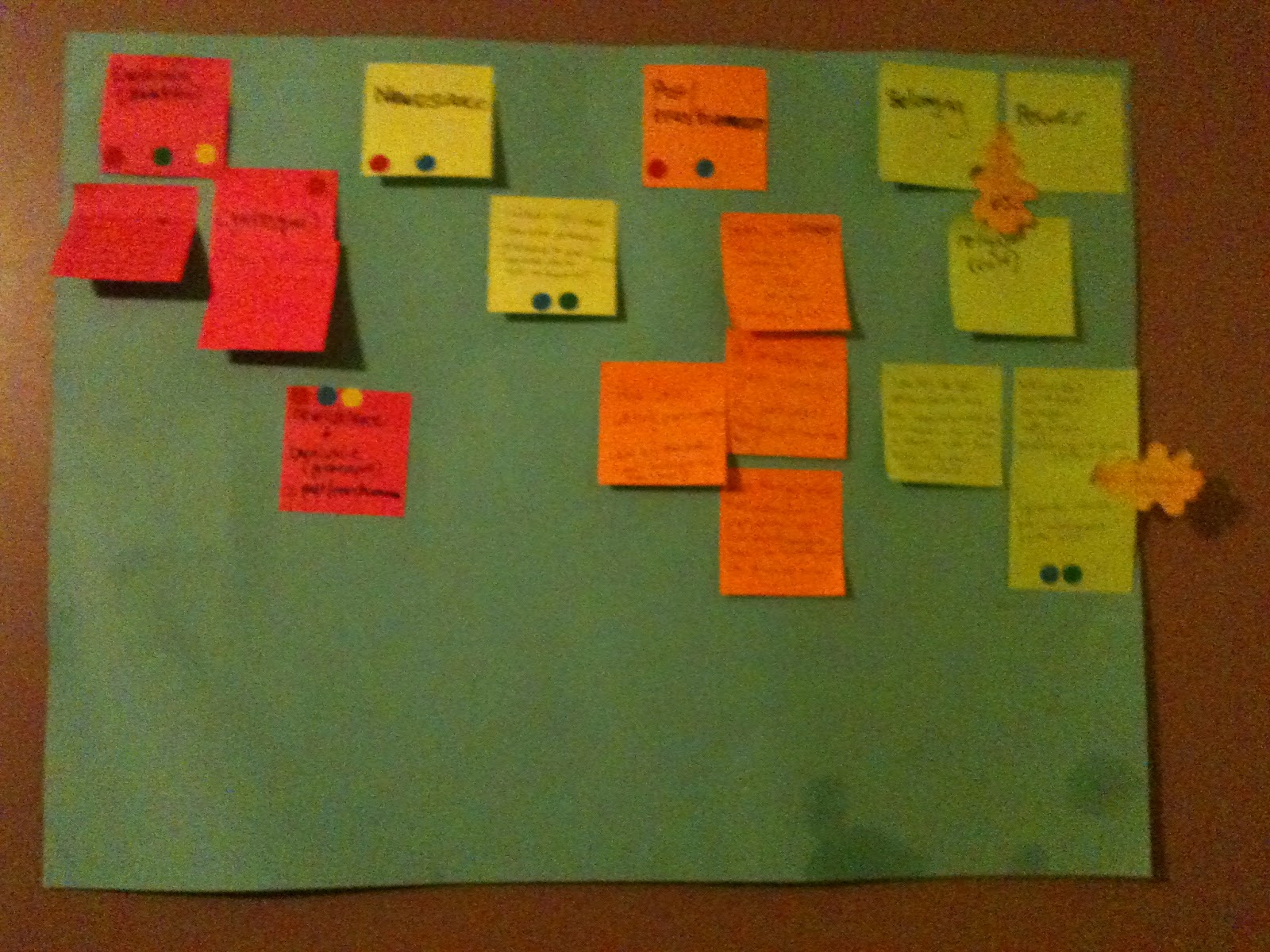
So, after this week, my ideas board looks like this.

Neuroscience (yellow sticky notes) is looking a bit empty while post/transhumanism (orange) and belonging vs power (green) are coming along nicely with carnivale (pink) close behind them. Not that it's a race or anything...

Most important thing is, the connections are starting to appear.

Wednesday, 20 February 2013

Bypassing the middle, skipping to the end

In December 2012 I got the great news that I'd been awarded a scholarship to study my PhD full-time. Although the part-time study worked well for me at first, I'd reached a point where just grabbing a few hours here and there to devote to my research wasn't working. I'd start gathering ideas and pursuing a line of thought and bang - it'd be back to the day job. This meant I couldn't really bring my thoughts and ideas together, and I felt I was doing a lot of stopping and starting.

I had a few things to sort out but finally the time has arrived that I can get stuck into my PhD as a full-time student. I'm all too aware of how fast time can pass, though, so I'm determined to make sure I don't waste any time. (Ok, there may be the odd half hour here & there devoted to watching soap operas). So today I've organised my desk, done up a new project plan and set up a 'ideas board' on my wall (basically a bit piece of cardboard that will eventually be covered with sticky notes).

My PhD is creative-practice led, and the manuscript is well under control. So the next few months are all about trying to work out 'what it all means'. According to my ideas board, the four main ideas/themes underpinning my work are:

  • neuroscience
  • carnivale and the grotesque
  • post/transhumanism
  • belonging
My job is to somehow bring the threads of these themes together in a coherent way in a 30,000 word exegesis that supports/expands upon my creative practice (a 65,000 word manuscript). I've done a lot of reading on neuroscience, waded my way through Bahktin's Rabelais and his World, got a basic grip on the grotesque but I'm still trying to get my head around posthumanism/transhumanism. So, for the next few weeks at least, that's where I'll focus my reading.

I started off today with reading the final chapter of Katherine Hayles' How We Became Posthuman and was intrigued by some of the arguments/ideas she put forward. I particularly liked the idea that the posthuman is not necessarily apocalyptic, and that "...we can craft others that will be conducive to the long-range survival of humans and of the other life-forms, biological and artificial, with whom we share the planet and ourselves."

If there are any must-reads people can recommend on posthumanism and transhumanism, I'd really appreciate it if you let me know about them.


Thursday, 15 September 2011

Are we in danger of going neuro nuts?

The Neuro Revolution by Zach Lynch (with Brian Laursen) gives a great overview of all the fields where neuroscience is, or is about to, have an impact. And from the obvious (like medicine) to the unexpected (like theology) neuroscience seems to be everywhere.

Aside from 'neuro revolution", Lynch names, among other things, neuroeconomics, neurofinance, neuroenablement, neuroenhancement, neuroesthetics, neuroethics, neurolaw, neuromarketing, neurospirituality and neuroentertainment.

It's enough to send anyone neuronuts!

Lynch writes with an enthusiasm that borders on evangelism, and sometimes, I think, lets his enthusiasm get the better of him. There were a couple of times while reading the book that I picked up some errors in research, and some glossing over of important points. (But maybe I'm just jealous - the only real difference between Lynch and me is that he's got the money and contacts to support his neuro-obsession and I don't...okay, there are probably other differences, but I digress.)

No book is perfect, including this one, but that doesn't take away from the incredible range of once totally unrelated fields that neuroscience is now involved in, and Lynch does a great job of giving some insight into where each of these fields might be heading.

Which makes me wonder, are we heading into a period of 'brain worship'? By that I mean, is western culture (in particular) heading towards a place where the filter of neuroscience is layered over everything? A couple of interesting research papers that I've read for my PhD research come to mind.

In 2008 Weisberg et al published an article in the Journal of Cognitive Neuroscience that showed including “...irrelevant neuroscience in an explanation of psychological phenomena may interfere with people’s abilities to critically consider the underlying logic of [the] explanation.”. Both general public and first year neuroscience students were swayed by the irrelevant neuroscientific facts. Similarly, a study by Simon Cohn on the meanings attached to brain scans by psychiatric patients, published in 2008, found that many patients:

"...tend to assume, irrespective of the complex technical processes, that [the scan] is a straightforward picture of inside their head: ‘I think it’s weird  – to think that’s me inside [and] that those colours show what I’m thinking.’"

It's human to want to know as much about the mystery of ourselves as we can. The ability to look inside the human brain in more or less real time appears to offer us the answers to the secrets locked up inside ourselves, and this is a powerful attraction. However, just as a brain scan is not a picture but rather a complicated composite of algorithms, of educated guesses and data excluded or highlighted, the allure of neuroscience and the answers it appears to offer us is no simple thing.

Lynch writes in his conclusion, "Like the gigantic shifts of humanity's past, our emerging neurosociety is a wildcard. It holds enormous, seemingly equal promise for inducing an age of bliss or a living nightmare." I agree, and I think one of the big dangers may be people being too keen to look to the human brain for all the answers.

The human brain is incredibly complex. Life is even more complex. And we're kidding ourselves if we think all the answers to life's problems can be served up to us on a nice, neat neuroscientific platter.