Most of my reading over the past week has focused on posthumanism and I've stumbled across a few really good articles. Often it seems the right article just seems to turn up unexpectedly in search results when I was looking for something else.
One of these was Elaine Ostry's "Is He Still Human? Are you?": Young Adult Fiction in the Posthuman Age (2004). Apart from giving a comprehensive overview of young adult titles that deal with posthuman themes pre-2004, it also gave me some excellent material I can use to help me position my manuscript within the speculative fiction genre. Ostry's articles discusses the idea that children are already living in a posthuman world, growing up in it, and so are the most likely to be affected by it. She uses Francis Fukuyama's three main categories of posthuman - neuropharmacology, prolongation of life, and genetic engineering - as a framework to discuss several young adult novels, many of which I was unfamiliar with (although the themes and plots were quite familiar). Ostry's view is that exploring the ramifications of the posthuman is important to young adults as 'Through literature, young adults can become aware of, and participate in, the debates surrounding biotechnology.' This is something I relate to as one of my aims in writing about neuroscience and neuroscientific themes in young adult fiction is as a way for young adults to explore the implications of the "neurorevolution" and what it means for them and the world they are inheriting.
Another article discussing Fukuyama's views of posthumanism also caught my attention this week: Daniel T O'Hara's Neither Gods nor Monsters: An Untimely Critique of the "Post/Human" Imagination (2003). While Ostry is clearly a fan of Fukuyama's, I'm not so sure about O'Hara, as in his article he describes Fukuyama as a 'conservative populist' in a way that makes me think this is not a good thing to be. Anyway, name calling aside, O'Hara is clearly some sort of genius with an incredible knowledge of pretty much every philosopher around and basically blew my mind by explaining how he sees Nietzsche's and Heidegger's theories on will and power relating to posthumanism. Even more interesting was the series of questions he raised at the end of his article:
'That insatiable modern will-to-will indeed will, no must, not rest, cannot rest because its only aim is an impossible infinite self-enhancement. But what if the universe is as perfect as it can be already at every moment, and what if any change, however tiny, however carefully done, means everything is abolished as it is, and so all begins to swing wildly out of kilter...wobbling ever more crazily toward an absolute chaos...'
The phrase 'impossible infinite self-enhancement' appeals to me because I think this may be where one of my main characters, Quarter, is heading (although he probably doesn't quite realise it himself). It also ties in nicely with the criticism of neuroscience, expressed in Thornton's 2011 book Brain Culture and in some of the writings coming out of the Critical Neuroscience group, that certain sections of the "neurorevolution" push humans (or whatever we are becoming) to aim for an essentially unachievable goal of perfection.
So, after this week, my ideas board looks like this.
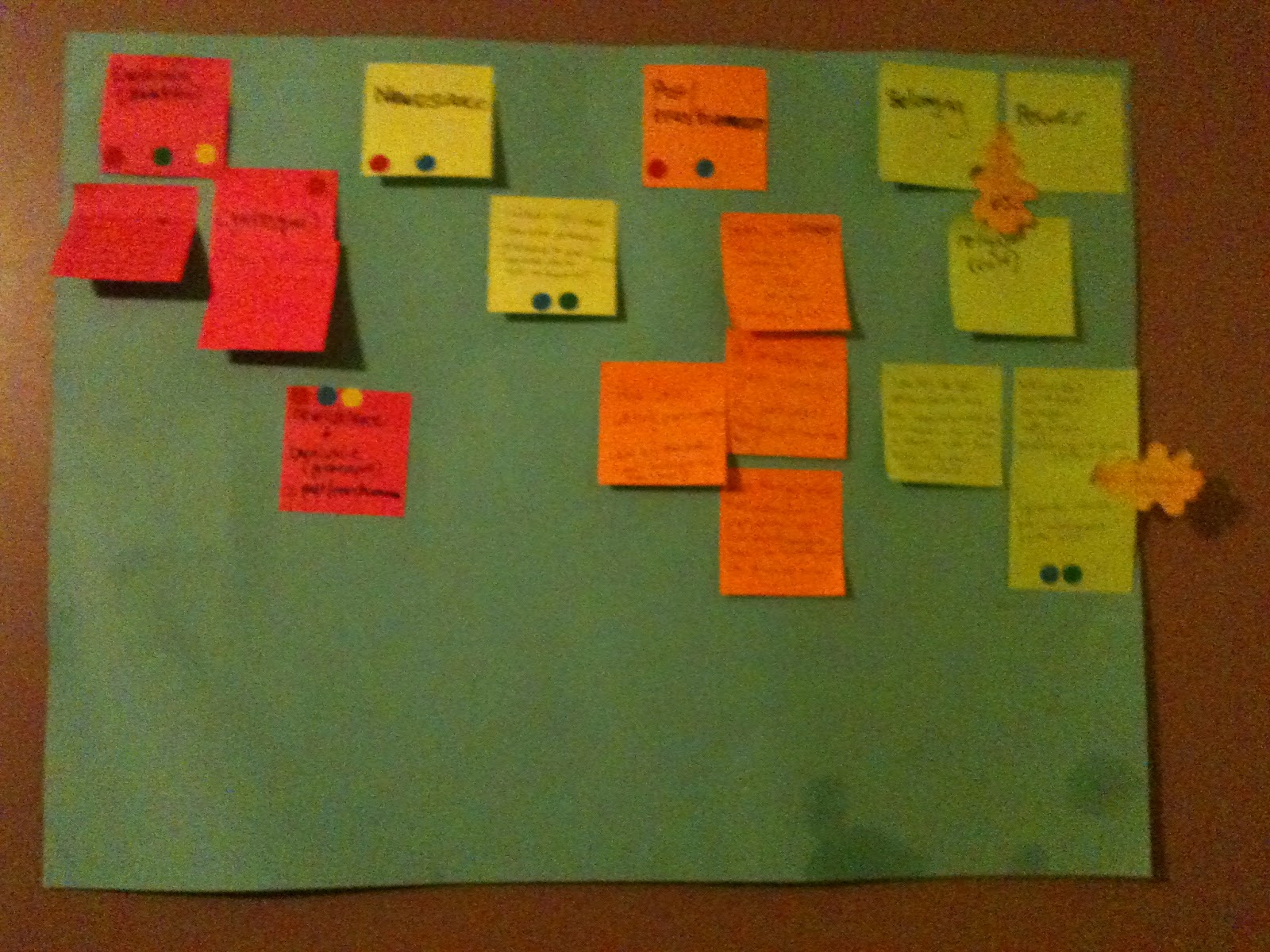
Neuroscience (yellow sticky notes) is looking a bit empty while post/transhumanism (orange) and belonging vs power (green) are coming along nicely with carnivale (pink) close behind them. Not that it's a race or anything...
Most important thing is, the connections are starting to appear.
Showing posts with label young adult fiction. Show all posts
Wednesday, 27 February 2013
Sunday, 29 August 2010
Picking the pieces out of my brain
If I didn't know better, I'd think some bizarre being has visited me in the dead of night and performed a quick and nasty frontal lobotomy with a rusty ice pick. I know I've been doing research and reading for the past 2 weeks but when I try to summarise it, all the bits of information scuttle off and hide somewhere in the recesses of my sulci (or is that gyri?). But anyway, here goes.
Fiction
In the last couple of weeks I've been ripping through some great YA fiction. First up was Cory Doctorow's latest For the Win. I really enjoyed it but it was an odd book, combining the gaming world with unionism, violence, communism, a touch of neuroscience and lectures on the basics of economics as it plays out in both the real and virtual worlds. It had a wide cast of characters placed across the globe, from hard core gangster bosses to rich nerds to a pirate radio host inciting factory girls to unite for the common cause of the worker. Not what you'd usually expect from YA fiction but, apart from the occasional lapse into didactism, this was a great story. Fast-paced, well plotted, lots of action, it's a story that keeps humming along. I haven't read many reviews of it so I'm not sure how it's faring yet with the target audience. It'll be interesting to see, as in some respects Doctorow has achieved something similar to what I'd like to do, in combining topics you wouldn't necessarily consider 'young adult' into a fast-paced narrative.
Suzanne Collin's Catching Fire, the second in her Hunger Games trilogy, is one that has no shortage of glowing reviews from fans. I haven't read book one yet but found no problem getting right into this second installment. Although the basic plot was one that's been done before in the sci-fi genre over the years, Collins' characters make the narrative vivid and exciting. The created world is believable, the plot reasonably simple while maintaining strong interest with some great twists and turns (I loved the big 'wedding dress' reveal) but it is the characters that really pull you in. The fear, dread and confusion the narrator, Katniss, feels is palpable all the way through. She is stuck in a no-win situation but pushes through each and every thing that is thrown at her. A real gutsy heroine (unlike some other wussy female protagonists around at the moment), and a character to inspire.
Research
I've got through most of the first volume of Neuroconstructivism and think I have it pretty much under control. I've also skimmed through a few articles reveiwing Maraschel et al's work, most seem to be overall positive (though I did have a giggle at one that said he was annoyed that the authors hadn't cited other researchers in the field and then said he was one). So, it's accepted as a valid (if not perfect) framework and it'll do just fine by me. Next I'm tackling Fundamentals of Human Neuropsychology. It covers everything I could ever possibly want or need to know on the subject, but, seeing as I'm a fiction writer and not a neuropsychologist, just a skim over the good bits will do. But I have enjoyed the first chapter which covers a bit of the history of the brain and how it's been perceived and studied over the centuries. One thing stood out - people have made huge mistakes and crazy assumptions about the workings of the human brain. And although technology such as fMRIs are making the study of the brain much easier in some ways, it seems the more that science uncovers, the more problems about the brain there are to solve.
No wonder so many find it so fascinating.
Fiction
In the last couple of weeks I've been ripping through some great YA fiction. First up was Cory Doctorow's latest For the Win. I really enjoyed it but it was an odd book, combining the gaming world with unionism, violence, communism, a touch of neuroscience and lectures on the basics of economics as it plays out in both the real and virtual worlds. It had a wide cast of characters placed across the globe, from hard core gangster bosses to rich nerds to a pirate radio host inciting factory girls to unite for the common cause of the worker. Not what you'd usually expect from YA fiction but, apart from the occasional lapse into didactism, this was a great story. Fast-paced, well plotted, lots of action, it's a story that keeps humming along. I haven't read many reviews of it so I'm not sure how it's faring yet with the target audience. It'll be interesting to see, as in some respects Doctorow has achieved something similar to what I'd like to do, in combining topics you wouldn't necessarily consider 'young adult' into a fast-paced narrative.
Suzanne Collin's Catching Fire, the second in her Hunger Games trilogy, is one that has no shortage of glowing reviews from fans. I haven't read book one yet but found no problem getting right into this second installment. Although the basic plot was one that's been done before in the sci-fi genre over the years, Collins' characters make the narrative vivid and exciting. The created world is believable, the plot reasonably simple while maintaining strong interest with some great twists and turns (I loved the big 'wedding dress' reveal) but it is the characters that really pull you in. The fear, dread and confusion the narrator, Katniss, feels is palpable all the way through. She is stuck in a no-win situation but pushes through each and every thing that is thrown at her. A real gutsy heroine (unlike some other wussy female protagonists around at the moment), and a character to inspire.
Research
I've got through most of the first volume of Neuroconstructivism and think I have it pretty much under control. I've also skimmed through a few articles reveiwing Maraschel et al's work, most seem to be overall positive (though I did have a giggle at one that said he was annoyed that the authors hadn't cited other researchers in the field and then said he was one). So, it's accepted as a valid (if not perfect) framework and it'll do just fine by me. Next I'm tackling Fundamentals of Human Neuropsychology. It covers everything I could ever possibly want or need to know on the subject, but, seeing as I'm a fiction writer and not a neuropsychologist, just a skim over the good bits will do. But I have enjoyed the first chapter which covers a bit of the history of the brain and how it's been perceived and studied over the centuries. One thing stood out - people have made huge mistakes and crazy assumptions about the workings of the human brain. And although technology such as fMRIs are making the study of the brain much easier in some ways, it seems the more that science uncovers, the more problems about the brain there are to solve.
No wonder so many find it so fascinating.
Sunday, 15 August 2010
Violence in YA fiction: to hold back or not?
I'm currently reading Robert Cormier's classic The Chocolate War. It's a YA book that's stood the test of time. In a poll of most loved YA books held in March 2010, it came in at number 61 - not bad for a book first published in 1974. And according to Wikipedia, it also came 3rd on the American Library Association's (ALA) list of the Top 100 Banned/Challenged Books in 2000-2009.
The edition I'm reading includes an introduction by Cormier, where he talks about the reasons why it was rejected by 7 major publishers before being finally accepted in 1973: "Too complicated. Too many characters. A downbeat ending, which teenagers of the 1970s would find difficult to accept. Too violent." Considering its top 3 appearance on the ALA's recent banned/challenged list, clearly many adults are still challenged by the story: violence, sex and drug use are most cited as reasons why it should be banned or restricted. But its ongoing popularity proves that teens connect with the book.
In her recent essay Narrative as Nourishment, literary theorist Ellen Spolsky discusses Paul Hernadi's argument that "...the creation and consumption of fictional narratives provide evolutionary advantages to a group, preparing them to anticipate challenges they may some day face by familiarizing their young with a range of hypothetical scenarios." Spolsky goes onto discuss how common themes in narratives can point to problems that artists and society are struggling with, however, while the narratives can't always provide answers or solutions they can nonetheless help us deal with them.
Cormier doesn't hold back on the violence in his book, which is one of the reasons it is challenged. But the honesty in Cormier's writing, which he held onto despite the many rejections received from publishers, is probably what appeals to his teen audience. By writing honestly about issues bullying and violence, Cormier both validates the experiences of teens and refuses to patronise them by taking the story through to its inevitable and confronting (unhappy) ending. And taking into account Hernadi's theory, Cormier's narrative may help teen readers work out how to deal with similar situations in their own lives; while Spolsky's views suggest that even if the narrative doesn't point to a solution it may help readers cope with experiences of bullying or violence.
I had a discussion with my supervisor earlier in the week about the depiction of violence in my own writing. She asked if I felt I was holding back, and I admitted that yes, probably I was. But now I know I have no excuse. As a writer one of my main responsibilities is to be true to the story and treat my future readers with respect by writing honestly. And if one day I can get my book simultaneously in the most popular and most banned lists, I'll know I've done really well.
The edition I'm reading includes an introduction by Cormier, where he talks about the reasons why it was rejected by 7 major publishers before being finally accepted in 1973: "Too complicated. Too many characters. A downbeat ending, which teenagers of the 1970s would find difficult to accept. Too violent." Considering its top 3 appearance on the ALA's recent banned/challenged list, clearly many adults are still challenged by the story: violence, sex and drug use are most cited as reasons why it should be banned or restricted. But its ongoing popularity proves that teens connect with the book.
In her recent essay Narrative as Nourishment, literary theorist Ellen Spolsky discusses Paul Hernadi's argument that "...the creation and consumption of fictional narratives provide evolutionary advantages to a group, preparing them to anticipate challenges they may some day face by familiarizing their young with a range of hypothetical scenarios." Spolsky goes onto discuss how common themes in narratives can point to problems that artists and society are struggling with, however, while the narratives can't always provide answers or solutions they can nonetheless help us deal with them.
Cormier doesn't hold back on the violence in his book, which is one of the reasons it is challenged. But the honesty in Cormier's writing, which he held onto despite the many rejections received from publishers, is probably what appeals to his teen audience. By writing honestly about issues bullying and violence, Cormier both validates the experiences of teens and refuses to patronise them by taking the story through to its inevitable and confronting (unhappy) ending. And taking into account Hernadi's theory, Cormier's narrative may help teen readers work out how to deal with similar situations in their own lives; while Spolsky's views suggest that even if the narrative doesn't point to a solution it may help readers cope with experiences of bullying or violence.
I had a discussion with my supervisor earlier in the week about the depiction of violence in my own writing. She asked if I felt I was holding back, and I admitted that yes, probably I was. But now I know I have no excuse. As a writer one of my main responsibilities is to be true to the story and treat my future readers with respect by writing honestly. And if one day I can get my book simultaneously in the most popular and most banned lists, I'll know I've done really well.
Saturday, 26 June 2010
Goodman's The other side of the island: simple language and complex concepts
Allegra Goodman's The other side of the island tackles some big issues for a kid's book aimed at around the 10-13 year age group. Climate change, government control, the corporate co-opting of religion and the high cost of individual thinking are all explored within this novel's dystopian world. Honor, the protagonist, lives on Island 365 where the seemingly benevolent Earth Mother holds absolute rule, protecting the earth against 'old weather' by 'ceiling' the few islands left inhabitable after environmental disaster. Each family is allowed only one child, whose name is chosen from an approved list; neighbourhood watchers ensure that citizens abide by curfews; and 'orderlies', bald, blank-faced creatures who look and act the same, exist as a sub human species silently performing menial jobs. But to Honor, this world is 'safe' and 'secure'. She strives for approval at her strict school and is horrified by her parents unwillingness to conform. In an act of teenage defiance, she changes her name from Honor, which with its silent H marks her as different, to Heloise. Soon after, her parents disappear, Honor is relegated to the lowly status of orphan and she begins to discover that Earth Mother's world is not so safe and secure after all.
The other side of the island is a fast-paced, enthralling book that follows Honor's maturing from a confused child to courageous freedom fighter. It has a lot to offer in relation to my research, particularly in relation to successful world-building and combining complex concepts within a fast-paced narrative that uses deceptively simple language and sentence structure. It also indirectly addresses neuro-scientific concepts, particularly in relation to the orderlies who are kept in a zombie-like state through the mind-numbing drugs in their food.
I'd been playing with the idea of locating my creative work on an island split down the middle by difficult terrain and I picked up this book from the library based on its title to see how the author handled it. The isolation of an island lends itself well to a controlled environment while also allowing the possibility of wild, harsh and unpredictable terrain hiding secrets and mysteries, and Goodman deftly manages these aspects in building Honor's world. While she is frightened of the untamed nature of the other side of the island, Honor comes to appreciate its natural beauty and accept that being safe and secure in Earth Mother's world comes at a high price.
Goodman also excels at weaving complex concepts while using deceptively simple language. Her use of short, sharp sentences and key words such as 'safe', 'secure', 'untruths', 'ceiled', 'enclosed' and 'correct', (identified as important through the use of quotation marks) express the essence of the corporate-controlled world of Island 365. Goodman's ability to load simple words with layers of meaning through context is, for me, one of the most impressive aspects of her writing.
I'll be looking out for more of this author's work.
The other side of the island is a fast-paced, enthralling book that follows Honor's maturing from a confused child to courageous freedom fighter. It has a lot to offer in relation to my research, particularly in relation to successful world-building and combining complex concepts within a fast-paced narrative that uses deceptively simple language and sentence structure. It also indirectly addresses neuro-scientific concepts, particularly in relation to the orderlies who are kept in a zombie-like state through the mind-numbing drugs in their food.
I'd been playing with the idea of locating my creative work on an island split down the middle by difficult terrain and I picked up this book from the library based on its title to see how the author handled it. The isolation of an island lends itself well to a controlled environment while also allowing the possibility of wild, harsh and unpredictable terrain hiding secrets and mysteries, and Goodman deftly manages these aspects in building Honor's world. While she is frightened of the untamed nature of the other side of the island, Honor comes to appreciate its natural beauty and accept that being safe and secure in Earth Mother's world comes at a high price.
Goodman also excels at weaving complex concepts while using deceptively simple language. Her use of short, sharp sentences and key words such as 'safe', 'secure', 'untruths', 'ceiled', 'enclosed' and 'correct', (identified as important through the use of quotation marks) express the essence of the corporate-controlled world of Island 365. Goodman's ability to load simple words with layers of meaning through context is, for me, one of the most impressive aspects of her writing.
I'll be looking out for more of this author's work.
Sunday, 30 May 2010
How much world do you need to build?
As much as I enjoyed Dunn's Geek Love, there was one aspect that niggled: the fact that a seemingly 'normal' world accepted a circus of freaks, particularly one that displayed 'freak feotuses',without the parents being arrested & the kids being hauled off to foster care. True the outside world didn't intrude too often into the narrative but it was always there in the background, particularly when the children are attacked by a gunman and are taken to hospital. There was no reason in this normal world for the bizarre and illegal behaviour of the parents to be accepted, let alone not be prosecuted. The logic of this bugged me (although I could easily accept the crazy behaviour of the Arturian cultists in removing all their limbs one by one). And it started me thinking about world building - how much do you need, and how much should you expect a reader to accept when it comes to internal logic?
After finishing Geek Love I moved onto YA fiction with Scott Westerfield's Uglies series. (For the record, Westerfield's lifestyle as an author who splits his time between Australia & NYC has my jealousy bugs frothing at the mouth.) I'm currently about two thirds through the first book in the series, Uglies, where Westerfield has set up a future society that follows these basics: children are born & live with their parents until they're 12, they're then sent to the charmingly named Uglyville a boarding school type environment where they live until their 16th birthday and then have an operation to turn into 'pretties'; they then live in New Prettytown until they become 'middle pretties' and partner and become parents & the cycle continues. Nice and simple. Westerfield refers to the existence of other cities elsewhere in the world that operate on similar lines but the characters have little interest in these places. But of course there is an outside world that does come into conflict with the orderly existence of Uglies/Pretties, known as the smoke, an abandoned city once ruled by the Rusties whose environmental wastefulness destroyed their way of life some centuries ago.
I like Westerfield's world building. It's nice and neat and logical. You could dig deeper and nit pick if you wanted to but I think the world he's created works really well for the young adult audience and the fast-paced action distracts the reader from a desire to poke holes in the story's created world.
This is something I need to learn from. I need to build a simple yet solid world that has enough internal logic to hold it together without getting lost in a myriad of detail. I need to stop second guessing myself and trying to create a world that's bigger than Ben Hur with a lot of unnecessary detail that will only bog me down. Or even worse, stop me from writing anything at all.
After finishing Geek Love I moved onto YA fiction with Scott Westerfield's Uglies series. (For the record, Westerfield's lifestyle as an author who splits his time between Australia & NYC has my jealousy bugs frothing at the mouth.) I'm currently about two thirds through the first book in the series, Uglies, where Westerfield has set up a future society that follows these basics: children are born & live with their parents until they're 12, they're then sent to the charmingly named Uglyville a boarding school type environment where they live until their 16th birthday and then have an operation to turn into 'pretties'; they then live in New Prettytown until they become 'middle pretties' and partner and become parents & the cycle continues. Nice and simple. Westerfield refers to the existence of other cities elsewhere in the world that operate on similar lines but the characters have little interest in these places. But of course there is an outside world that does come into conflict with the orderly existence of Uglies/Pretties, known as the smoke, an abandoned city once ruled by the Rusties whose environmental wastefulness destroyed their way of life some centuries ago.
I like Westerfield's world building. It's nice and neat and logical. You could dig deeper and nit pick if you wanted to but I think the world he's created works really well for the young adult audience and the fast-paced action distracts the reader from a desire to poke holes in the story's created world.
This is something I need to learn from. I need to build a simple yet solid world that has enough internal logic to hold it together without getting lost in a myriad of detail. I need to stop second guessing myself and trying to create a world that's bigger than Ben Hur with a lot of unnecessary detail that will only bog me down. Or even worse, stop me from writing anything at all.
Subscribe to:
Posts (Atom)
